The Ferranti Effect: A Complete Technical Guide
Why sending-end voltage becomes higher than receiving-end voltage on long, lightly loaded AC transmission lines
🔍 1. What Is the Ferranti Effect?
The Ferranti Effect is a phenomenon where the receiving-end voltage of a long AC transmission line becomes higher than the sending-end voltage, even though no mechanical tap-up or control action is applied.
This effect occurs when:
-
The line is long (typically > 200 km for EHV AC)
-
The line is lightly loaded or open-circuited
-
The system voltage is high (≥ 220 kV)
In short:
👉 Light load + long AC line = voltage rise at the receiving end
Because the line’s distributed capacitance draws a leading charging current, causing voltage amplification toward the receiving end.
⚙️ 2. Why the Ferranti Effect Happens
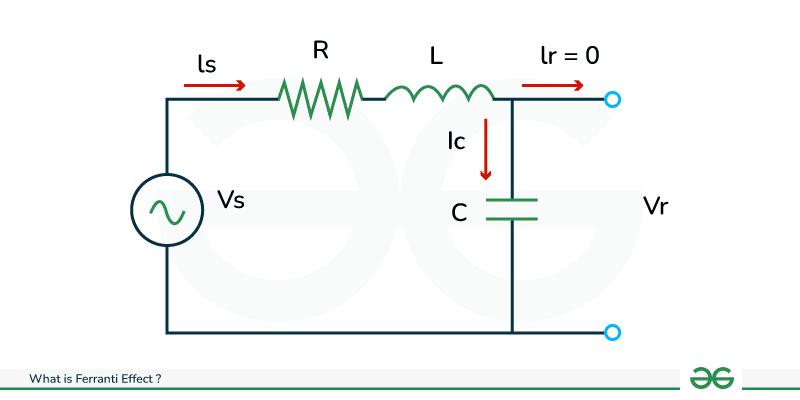
Long AC lines behave like distributed RLC circuits.
When there is little or no load:
1️⃣ The line capacitance draws a leading charging current
Transmission lines have inherent capacitive effects:
-
Conductor-to-earth capacitance
-
Conductor-to-conductor mutual capacitance
This causes charging current:
This charging current leads the voltage by 90°.
2️⃣ Line inductance creates reactive voltage drop
The line inductance (L) creates voltage rise when the current is leading:
Thus:
-
Capacitive reactive power is generated along the length
-
Inductive voltage rise adds to the magnitude
-
Voltage at the receiving end increases
3️⃣ Distributed parameters amplify the effect
In long lines, the effect compounds along each small segment.
📏 3. Mathematical Explanation
For a lossless line:
Under open-circuit condition:
Thus:
Because:
➡️ Receiving-end voltage > Sending-end voltage
Where:
-
= propagation constant
-
= line length
-
= surge impedance
The longer the line and the higher the voltage, the greater the voltage rise.
🧮 4. Numerical Example (Realistic EHV Case)
500 kV AC line, length = 300 km
Typical line parameters per phase:
-
Capacitance
-
Inductive reactance
-
No load at receiving end
Step 1 — Compute charging current
Over 300 km:
Step 2 — Voltage rise
Step 3 — Receiving-end voltage
➡️ Voltage rises by ~14%
This is a very typical Ferranti effect magnitude for long, lightly loaded AC lines.
🚨 5. Why the Ferranti Effect Is Dangerous
⚠️ Overvoltage on equipment
Insulators, transformers, arresters, and breakers can exceed BIL.
⚠️ Resonance conditions
Line capacitance + system inductance → resonance risk.
⚠️ Reactive power imbalance
Uncontrolled reactive power generation leads to:
-
Voltage instability
-
Under/overvoltage trips
-
Oscillations
⚠️ Parallel line interaction
Loaded and unloaded lines create:
-
circulating reactive currents
-
voltage imbalance
🛠️ 6. How Utilities Mitigate the Ferranti Effect
✔ 1. Shunt Reactors
This is the most common solution.
Reactors are placed:
-
at line ends
-
at intermediate substations
-
on tertiary windings
They absorb excessive reactive power:
✔ 2. Controlled Switching
Used on:
-
400 kV
-
500 kV
-
765 kV lines
Ensures the line is energized at the exact voltage minimum.
✔ 3. FACTS Devices
-
STATCOM
-
SVC
-
TCSC
-
MSC/MRC
Provide dynamic voltage control.
✔ 4. Line Shutoff / Reconfiguration
At night, some utilities:
-
open long lines
-
re-route load
-
reduce no-load energization
✔ 5. Bundled Conductors
Larger diameters reduce reactance and modify capacitance.
🔬 7. Systems Where Ferranti Effect Is Most Severe
-
500 kV, 735 kV, and 765 kV AC lines
-
Lines > 200 km
-
High-capacitance lines (closely spaced bundles)
-
Light-load conditions (nighttime, low demand)
-
Remote hydro → urban grid corridors
-
Offshore AC links (wind farms)
-
Mountain valley long-span lines


No comments:
Post a Comment