Ferranti Effect vs. Corona Effect vs. Reactive Power Effects
A complete technical comparison for long AC transmission lines
This is a new, standalone authority article, explaining how these three major AC phenomena differ, how they interact, and how engineers analyze them. Highly optimized for search engines and excellent as an anchor post.
If you want Blogger-ready HTML, just tell me after.
⚡ 1. Introduction
Long AC transmission lines exhibit several electrical phenomena that affect voltage, power flow, stability, and insulation requirements. Three of the most important are:
-
Ferranti Effect — voltage rises at the receiving end
-
Corona Effect — ionization of air around conductors
-
Reactive Power Effects — charging currents, VAR flow, power factor challenges
These phenomena are often confused, but they arise from different mechanisms, have different impacts, and require different mitigation strategies.
This article gives a deep technical comparison.
⚡ 2. Ferranti Effect
Voltage rise due to distributed capacitance
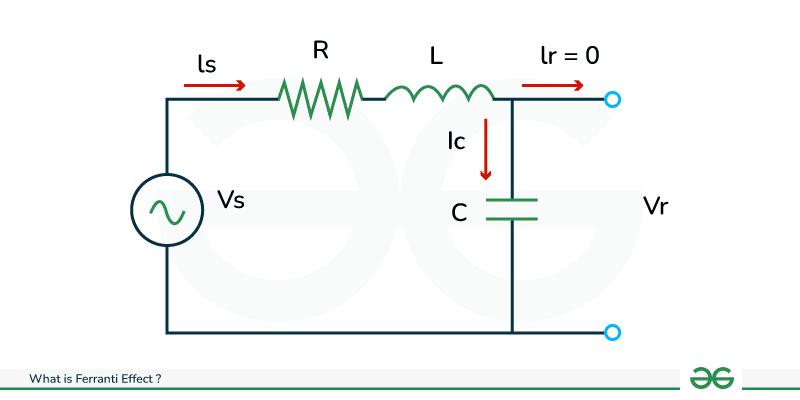
The Ferranti Effect occurs on long, lightly loaded AC transmission lines, causing the receiving-end voltage to exceed the sending-end voltage due to line capacitance and inductance interactions.
Root Mechanism
-
Line capacitance generates leading reactive power
-
This current leads voltage by 90°
-
Line inductance causes additional voltage rise
-
The rise compounds along the line (distributed effect)
Where .
When It Occurs
-
Line length > 200–250 km (AC)
-
Voltage level ≥ 220 kV
-
Light or zero load
Key Symptoms
-
Overvoltage at receiving end
-
VAR generation from line
-
Stress on insulators, arresters, transformers
Mitigation
-
Shunt reactors
-
Series compensation
-
Controlled switching
-
FACTS devices (STATCOM/SVC)
⚡ 3. Corona Effect
Ionization of air surrounding conductors under high electric stress
The Corona Effect is a localized surface phenomenon where air molecules near the conductor are ionized, causing:
-
power loss
-
audible noise
-
radio interference
-
UV light and ozone generation
Root Mechanism
Occurs when the electric field gradient exceeds the critical disruptive voltage:
Where:
-
= air density factor
-
= 30 kV/cm (breakdown electric field)
-
= surface irregularity factor
Key Symptoms
-
Purple glow around conductors
-
Audible humming
-
Radio interference (RIV)
-
Power loss due to ionization
Conditions That Increase Corona
-
High voltage
-
Bad weather (rain, fog, humidity)
-
Rough or dirty conductors
-
Small-diameter conductors
Mitigation
-
Bundled conductors (increase effective diameter)
-
Smooth, polished, or coated conductors
-
Corona rings at line terminations
-
Maintaining proper conductor spacing
⚡ 4. Reactive Power Effects
Behavior of inductive and capacitive VARs in long AC systems
Reactive power affects voltage control, stability, and line loading.
Root Mechanism
In AC systems:
-
Inductive components absorb VARs
-
Capacitive components generate VARs
Transmission lines generate capacitive VARs due to distributed capacitance:
Transformers and motors absorb inductive VARs.
Key Symptoms
-
Voltage instability (over/under-voltage)
-
Increased current flow
-
Reduced real power transfer capability
-
Oscillation risk
Causes in Transmission Lines
-
Light loading → capacitive VAR dominance
-
Heavy loading → inductive VAR dominance
-
Long 400–765 kV lines → high charging currents
Mitigation
-
SVC, STATCOM
-
Shunt reactors / capacitors
-
Series compensation
-
On-load tap-changing transformers (OLTC)


No comments:
Post a Comment